
If you follow the conversation around AI in market research, you'd think the industry's biggest problems are analysis and reporting. Conference agendas are packed with sessions on AI-generated insight summaries, automated theme detection in open-ends, and natural language querying of survey data. Vendors are racing to build the best "analysis copilot."
That work matters. But it addresses a problem that was already getting faster on its own. Researchers have been getting better at analysis for decades — better statistical tools, better visualization software, better training. AI accelerates an area that was already on an upward trajectory.
The area that hasn't improved in twenty years is the middle of the research workflow: survey programming — the step where a questionnaire document becomes a programmed survey.
What survey programming actually involves
For readers outside of research operations, "survey programming" sounds like it should be simple. You have questions. You put them in a survey tool. How hard can it be?
The answer is: surprisingly hard, because what looks like a questionnaire is actually a specification for a software application.
Consider a typical brand tracking study. The questionnaire document — usually a Word file or PDF, written by a researcher — might include:
- A screener section that qualifies respondents based on category usage, then terminates or routes them into different study arms
- Aided and unaided awareness questions where the brand list is randomized but anchored items ("None of the above," "Other") stay pinned to the bottom
- A loop that repeats a block of evaluation questions for each brand the respondent indicated awareness of — so if someone is aware of 3 out of 10 brands, they see the block 3 times with the brand name dynamically piped in
- Skip logic that says things like "If respondent rated brand satisfaction below 4 in any loop iteration, ask the open-ended follow-up for that iteration only"
- A MaxDiff or ranking exercise where the number of items depends on earlier responses
- Quota controls that balance the sample across demographics and interact with the screening logic
None of this is exotic. Any experienced researcher would recognize this study as moderately complex — not simple, but not unusual either. Studies like this run every quarter at thousands of companies.
Now translate that specification into working software. The programmer needs to:
-
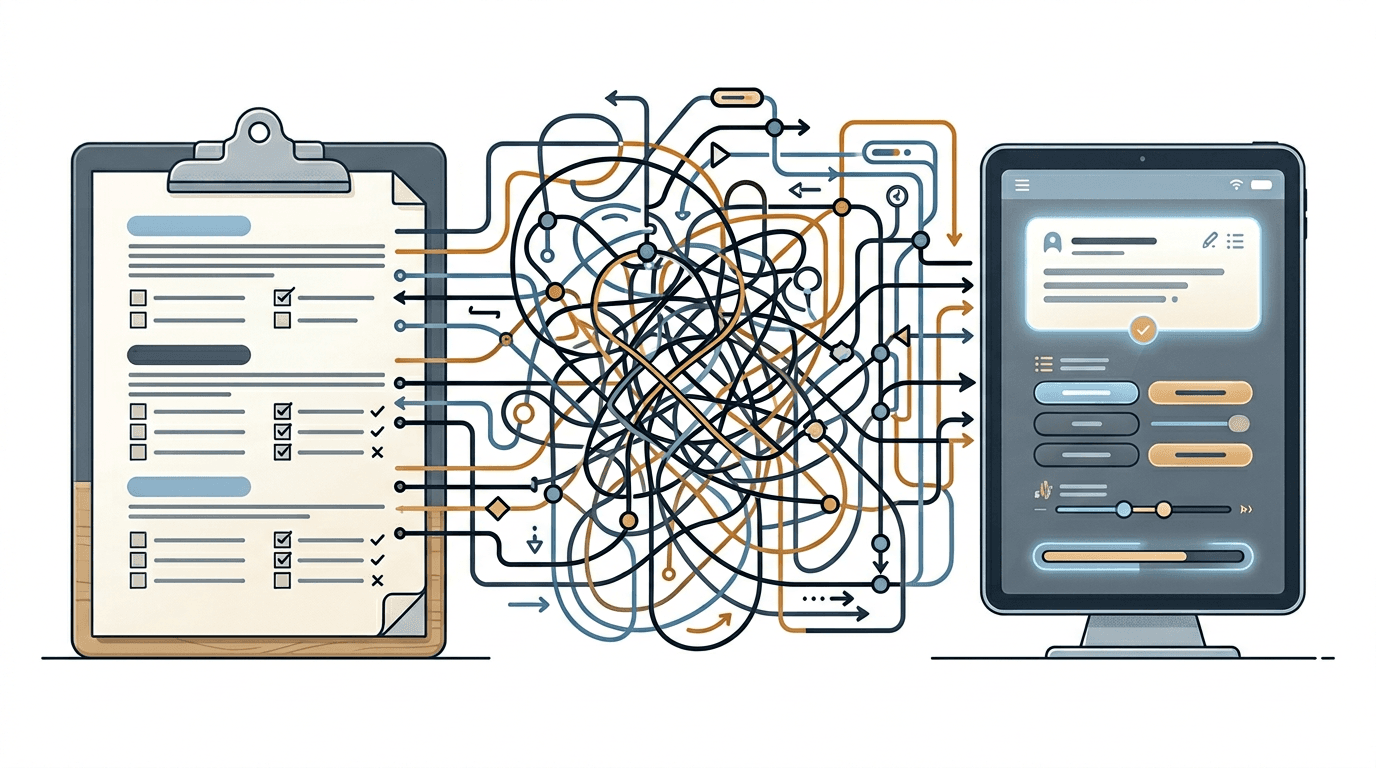
Parse the document. The spec isn't structured data. It's prose, tables, bullet lists, and occasionally hand-drawn arrows in the margin. The question "Ask Q12 only for brands selected in Q5" needs to become a conditional display rule referencing specific variable names — names that might not exist yet because the programmer is still building the survey.
-
Resolve ambiguity. The spec says "randomize the brand list." Does that mean fully randomize, or randomize within groups? Are there anchor items? What about "Other (specify)" — does it get a text box? The spec might not say. The programmer emails the researcher, waits for a reply, then continues.
-
Build the logic graph. Skip logic, display logic, piping, loops, and validation rules form an interconnected graph. Changing one condition can cascade through dozens of downstream elements. The programmer needs to hold this entire graph in their head while working through the spec sequentially.
-
Write platform-specific code. Decipher surveys are defined in Python-extended XML with a specific schema. Qualtrics uses a JSON-based QSF format with its own conventions for loop structures and embedded data. ConfirmIt has a form-based configuration system with scripting extensions. The same logical survey becomes completely different technical artifacts depending on the target platform.
-
Handle edge cases the spec didn't anticipate. What happens if a respondent qualifies for the main study but hits a full quota? What if the MaxDiff exercise has fewer items than expected because the respondent was only aware of 2 brands? The programmer has to make judgment calls or go back to the researcher for clarification.
For our moderately complex brand tracker, this process takes an experienced programmer 8 to 12 hours. A junior programmer might take two full days. And this is before any testing begins.
The testing problem compounds it
After programming comes link testing — the process of clicking through every path a respondent could take to verify that the survey works correctly. (Before you even get to link testing, you can measure programming accuracy itself with a free scorecard.)
For a linear survey with no branching, this is straightforward. But the brand tracker above isn't linear. It has:
- Multiple screening paths (qualify, disqualify, quota full)
- A variable-length loop (1 to 10 iterations depending on awareness)
- Conditional questions within the loop
- Display logic that depends on combinations of earlier answers
- Quota interactions that change routing based on how many respondents have already completed
The number of distinct paths through this survey is in the hundreds. A thorough tester might walk 15 or 20 of them — the most common paths and a few edge cases they can think of. That takes 2 to 4 hours. The rest is assumed to work.
Then the client reviews the test link, finds issues, and sends revisions. The programmer makes changes, and the testing cycle starts over. Two or three revision cycles is typical. Each one costs a half-day.
Add it up: programming (10 hours) + initial testing (3 hours) + revision cycles (8 hours) = roughly 20 hours of mechanical work before the study is ready to field. That's two and a half working days consumed entirely by translation — turning a specification that already existed into a technical implementation.
Research teams know this cost well. A team with two full-time programmers can handle maybe 15-20 moderately complex studies per month, depending on revision volume. That's the production ceiling. Every study above that number either waits in the queue, gets outsourced (at $1,500-3,000 per study for a freelance programmer), or gets simplified to reduce programming time — which means compromising the research design.
The 2025 GRIT Insights Practice Report identified a widening gap between what insights teams are asked to deliver and the resources they have to deliver it. The report focuses on budget pressure and AI adoption, but beneath those themes is a throughput problem. Teams can't do more research without doing more programming, and programming scales linearly with headcount.
Where AI in survey research has gone instead
The AI investment in market research has followed a predictable pattern. Vendors built tools for the stages of research that are most visible to stakeholders — the parts that produce deliverables:
- AI-moderated qualitative research that conducts interviews, probes on interesting responses, and synthesizes themes across conversations. These tools are expanding what's possible in qual, but they don't address the quantitative survey workflow — and the spec still needs to be programmed.
- Analysis and reporting tools that auto-generate summaries, detect themes, and create visualizations. These help researchers produce deliverables faster, but the deliverable is only as good as the data it's based on — and the data depends on a correctly programmed survey.
- Synthetic data and simulation tools that model respondent behavior or generate test data. Interesting for certain use cases, but they don't address the fundamental need to field real surveys.
What's missing is AI that addresses the translation step between spec and survey. This gap exists for a few reasons:
The problem is hard. Parsing unstructured documents, understanding survey semantics, and generating platform-specific output requires a combination of NLP, domain knowledge, and code generation that off-the-shelf language models don't do well out of the box. You can't just paste a questionnaire into ChatGPT and get a working Decipher survey.
The market is fragmented. Each survey platform has its own format, conventions, and limitations. A tool that generates Qualtrics surveys doesn't help Decipher users. Building for one platform is a significant engineering effort; building for multiple platforms is four separate efforts that share maybe 40% of the underlying logic.
The domain expertise is narrow. Survey programming knowledge sits at the intersection of market research methodology and software implementation. It's a small population of practitioners, which means less training data, less open-source tooling, and less venture capital attention than broader "AI for business" categories.
The result is that the highest-effort stage of the research workflow has received the least AI investment. Not because it's unimportant, but because it's hard to solve and hard to sell to executives who don't know it exists.
What automated survey programming could look like
Imagine the brand tracker I described earlier. The researcher finishes the questionnaire document — the same Word file they would have written anyway. Instead of sending it to a programmer and waiting two days, they upload it to a system that:
-
Reads the entire document and builds an internal model of the survey — not question by question, but holistically. It understands that Q5 is a multi-select brand list, that Q6-Q11 form a loop that repeats for each selected brand, and that Q12 is a conditional follow-up triggered by a threshold in Q9.
-
Resolves what it can and asks about what it can't. The document says "randomize the brand list" — the system randomizes and anchors "None of the above" at the bottom, because that's the convention. But the document also says "Ask awareness for relevant brands" without defining "relevant" — so the system flags that for the researcher to clarify.
-
Generates a complete, validated survey in the target platform's format. Not a partial draft that needs manual finishing. A survey with all questions, logic, piping, loops, validation rules, and display conditions implemented and cross-referenced.
-
Checks its own work before presenting it. Are all skip conditions referencing valid questions? Do all pipes resolve to existing response options? Are there unreachable questions or orphaned logic branches? The system catches the class of errors that programmers catch during testing — before a human even looks at it.
-
Produces output for the specific platform the team uses. Decipher XML if they're on Decipher. QSF if they're on Qualtrics. The same questionnaire, the same logic, different technical rendering.
The researcher's experience changes from "hand off the spec and wait two days" to "upload the document, review the output, and approve." The review step still requires human judgment — is this the right interpretation of the routing logic? Did the system handle the loop correctly? But review takes 30 minutes, not 10 hours.
The total cycle time for getting from final questionnaire to field-ready survey compresses from 2-3 days to under an hour. Not because corners are being cut, but because the mechanical translation step — the step that was always deterministic, always rule-based, and always tedious — is no longer manual.
Why this matters beyond efficiency
The second-order effects are more interesting than the time savings.
Research designs stop being constrained by programming complexity. When adding a loop or a complex skip pattern costs the researcher nothing in turnaround time, they design the study they actually want instead of the study that's feasible to program. The pragmatic simplifications that researchers make every day — "let's just make this a simple grid instead of a loop, it'll be easier to program" — go away.
Iteration becomes possible. Today, once a survey is programmed, changing the design is expensive. Moving a question block requires re-wiring the logic graph. Adding a screener condition means re-testing everything downstream. So researchers commit to designs early and resist changes even when new information suggests the design should evolve. When reprogramming is nearly free, the researcher can test different versions of the instrument before fielding.
Quality assurance gets better, not worse. This seems counterintuitive — if you're moving faster, shouldn't quality suffer? The opposite happens. An automated system applies the same validation checks to every survey, every time. It doesn't get tired on Friday afternoon. It doesn't miss a skip condition because it was interrupted by an email. The baseline quality of the mechanical implementation goes up, which means human review can focus on higher-order questions: does this survey measure what we need it to? Is the respondent experience reasonable? Are we asking the right questions in the right order?
Programmers don't disappear — they level up. The survey programmers I've worked with are sharp, detail-oriented people who understand both research methodology and platform mechanics. When the rote translation work is automated, they don't lose their jobs. They become technical reviewers, QA specialists, and platform consultants — roles that use their expertise for judgment instead of transcription.
The industry is starting to move
Greenbook's 2026 market research predictions identified "AI Specialization & Agentic Workflows" as the number one success factor for research firms this year, describing a shift "beyond basic automation to specialized research AI platforms." Forsta announced purpose-built research agents targeting specific stages of the research workflow. Attest's Sam Killip wrote in The New Insight Playbook for 2026 that "survey creation, structuring and programming have traditionally taken large amounts of time within research cycles."
The recognition is there. The conversation is shifting from "AI for insights" to "AI for the operational mechanics of research." Programming is the largest operational task in the workflow, and it's the one with the clearest path to automation — the inputs are well-defined (questionnaire documents), the outputs are well-defined (platform-specific surveys), and the transformation between them, while complex, is fundamentally rule-based and learnable.
The question isn't whether this middle step will be automated. It's how long teams will keep paying the manual tax before they stop.
Questra automates the programming step — from uploaded questionnaire to deployable survey on Decipher, ConfirmIt, Qualtrics, or Alchemer. Curious how accurate the output is? Try the free scorecard. Ready to start programming? Sign up.